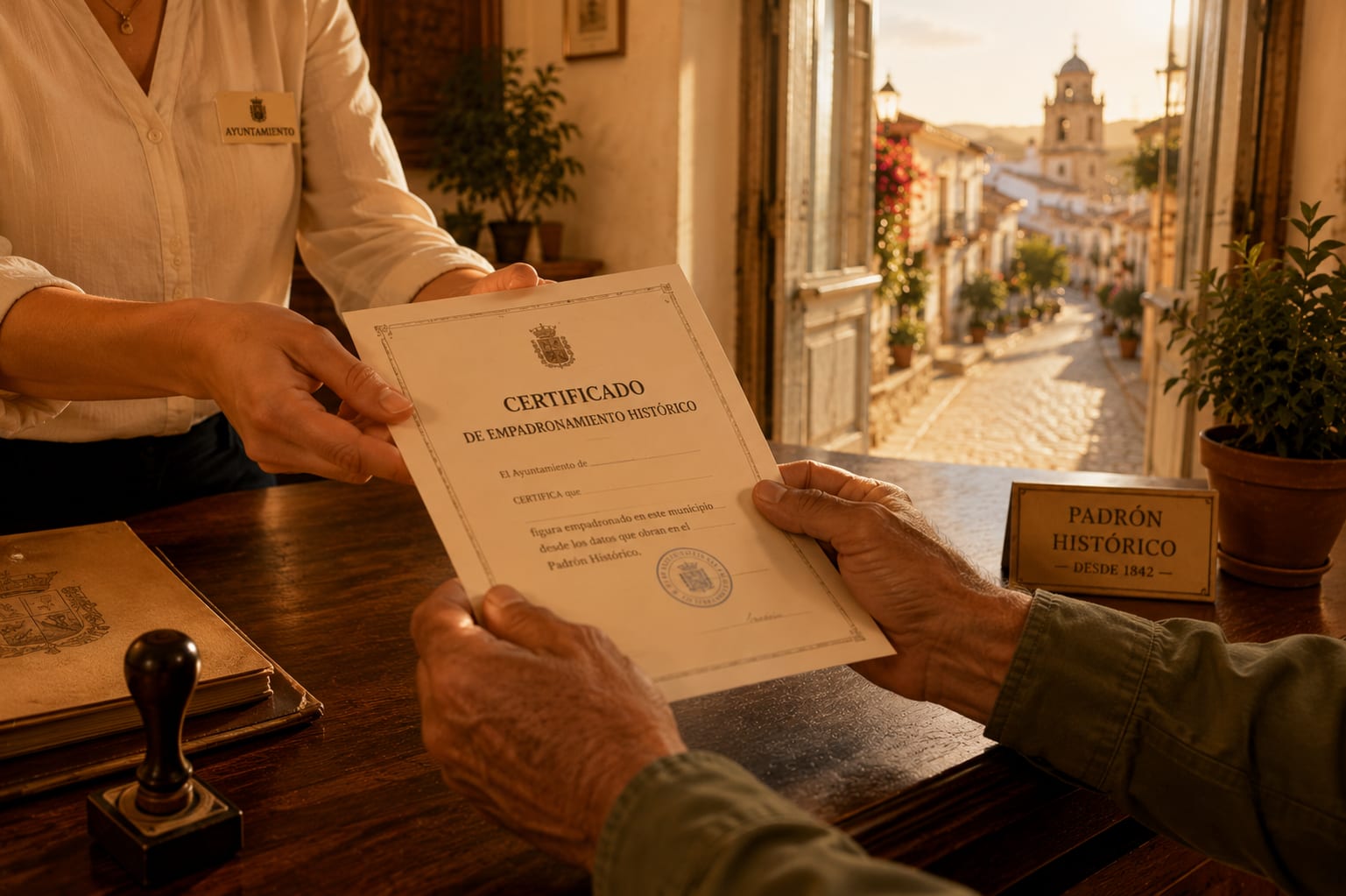
Nearly every residency route turns on one question: how long have you actually lived in Spain? The document that answers it — and wins cases — is the padrón histórico. Most people request the wrong version, so this is worth getting right.
Find your route in 10 minutes — free.
Start free diagnostic →What the padrón is
Empadronamiento is registering at the town hall (ayuntamiento) of the place you live. It's how Spain knows who lives where — and your registration date is the official record of when you started living there. See our NIE & empadronamiento guide for the basics.
Why "histórico" is the one you want
There are different certificates, and the difference matters:
- Volante / certificado de empadronamiento (actual) — shows only that you're registered right now.
- Volante / certificado histórico (or histórico-colectivo) — shows your full registration history with dates: when you registered, any address changes, and that your residence has been continuous.
It's that history with dates that proves the thing your case depends on — that you were here before 31 December 2020 (for the Withdrawal Agreement), or that you've lived here continuously for two, three or five years (for arraigo and Larga Duración).
A padrón histórico with an alta date before 31/12/2020 is, on its own, often the decisive proof in a late Withdrawal Agreement application.
How to get it
- Go to your ayuntamiento (many offer it online with a digital certificate or Cl@ve, others in person — book a cita if needed).
- Ask specifically for the certificado/volante de empadronamiento HISTÓRICO — not just the current one.
- It's usually free or a small fee, issued on the spot or within a few days.
If you're not yet on the padrón, register now — for most routes the clock that counts starts there. Pathway's free diagnostic tells you exactly which evidence your route needs.
Find your route in 10 minutes — free.
Start free diagnostic →